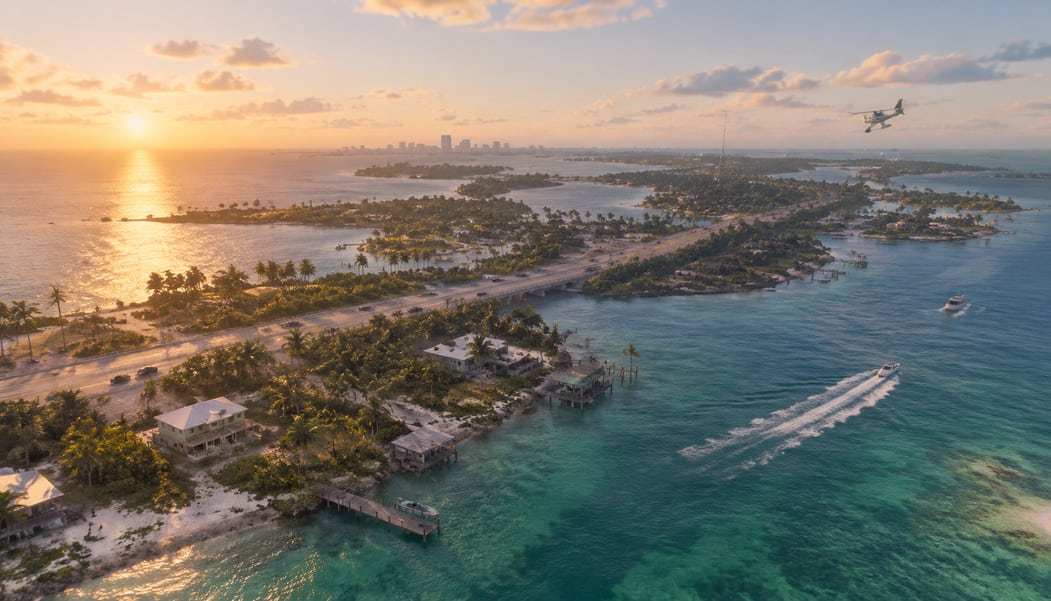

Leonida Keys connects GTA 6’s island setting to Jason Duval’s work for local drug runners. Brian Heder’s boat yard gives the region another direct link to the criminal trade, with coastal property serving an identifiable purpose in the story.
The information below separates published location details from gameplay features that still require verification. It does not assign speculative routes, purchase prices, or mission rewards to the region.
Players researching GTA 6 Money need documented costs and rewards before comparing coastal activities. Brian’s involvement in smuggling does not establish player payouts, operating expenses, or repeatable income.
Leonida Keys and Its Island Setting
Rockstar presents Leonida Keys as a tropical archipelago. Its island geography gives players a clear reason to examine how destinations connect, but the setting alone cannot establish which roads, crossings, or water approaches are usable.
A location visible across the water is not automatically a short trip. Before treating a marker as a practical destination, a route guide needs to identify the starting point, the approach, and any access conditions.
Published images can help readers recognize coastal buildings and shorelines. They cannot establish travel times or prove that every visible property has an accessible interior.
What a Reliable Island Map Should Show
A useful map distinguishes official location names from labels supplied by its creator. It should also separate confirmed destinations from positions estimated using promotional footage.
For a route to be reproducible, its description needs:
- A recognizable departure point.
- A clearly identified destination.
- The transport used for the approach.
- Any observed mission or access requirement.
Without those details, a marker is a reference point rather than a tested route. Precise distances and journey times should remain unlisted until they can be measured.
Waterways and Brian Heder’s Boat Yard
Brian Heder provides the clearest confirmed connection between the Keys’ waterfront and its smuggling trade. His character introduction describes an experienced drug runner who continues moving product through a boat yard with his wife, Lori.
That establishes the yard’s story function. It does not establish a player-owned business.
Purchasing the property, managing shipments, upgrading facilities, and collecting repeatable income are separate gameplay claims. None should be inferred simply because Brian operates there.
The distinction also matters when describing water routes. A smuggling operation can explain why characters use a coastal location without revealing the objectives, restrictions, or rewards of a playable mission. An earnings guide needs evidence of those mechanics before recommending a repeatable run.
Coastal Properties and Jason’s Residence
Jason’s connection to Brian extends to housing. Brian lets him stay at one of his properties without paying rent, provided Jason helps with local shakedowns.
The arrangement ties a residence to their working relationship. It does not, by itself, confirm the property’s full set of player functions.
| Property detail | What needs verification |
| Building access | Whether the interior is accessible and under what conditions |
| Vehicle storage | Whether a usable storage or parking function exists |
| Player facilities | Which interactions are available inside the property |
| Ownership | Whether the location can be purchased or is assigned through the story |
A residence should not be described as a fully documented safehouse until its functions have been checked. The same applies to other coastal buildings: a recognizable exterior is enough for a landmark entry, but not for an interior or property guide.
Cal Hampton and Coast Guard Communications
Cal Hampton is Jason’s friend and another associate of Brian. His introduction describes him listening to Coast Guard communications at home.
This detail contributes to his characterization. It does not confirm a player-controlled interception system, a patrol-tracking interface, or a method for avoiding pursuit.
Any guide recommending radio monitoring as a tactic would need to show an actual player interaction and explain what information it provides.
GTA 6 Money and Coastal Purchases
Before deciding to buy GTA VI Money for a boat or waterfront property, verify that the intended purchase exists in the relevant game mode and provides the function you need. A named location or a character’s business is not enough to support that spending decision.
A useful comparison should state the purchase or activity, its requirements, and the amount shown in the game. If a reward changes with completion conditions, those conditions belong beside the figure. Earnings-per-hour claims also need a measured completion time and an explanation of any costs deducted.
This guide does not assign a purchase price to Brian’s boat yard or claim that spending money unlocks access to the Keys.
Recording a Useful Coastal Route
Once gameplay access is available, test a short route before documenting a full regional circuit. Choose one destination and record how you reached it.
For a waterfront stop, identify the arrival point, where you left your transport, and which interactions were available. If you visited during a mission, include that context. Access observed in a scripted sequence needs a separate check before it can be presented as unrestricted exploration.
Keep route instructions specific. “Approach from the water” leaves the reader without a departure point or landing location. A usable entry identifies both, then records any obstacle or access condition encountered on the way.